Non-toxic polymer chemistry that bonds in-situ soil into a waterproof, high-strength surface. 40% lower cost. 3-hour cure. 25+ year lifespan. Zero quarrying required.
Conventional and concrete methods are capital-intensive, requiring extensive quarrying, long-haul transport, and heavy compaction of rock, stone, and fines.
Multiple material layers, deep excavation, and long curing times routinely push delivery schedules past deadlines, extending costly traffic diversions.
Traditional roads crack, washboard, and form potholes under heavy loads and weather cycling — creating a perpetual, expensive maintenance burden.
Water penetration into porous structures causes catastrophic freeze/thaw expansion — the single greatest structural failure mechanism in cold and extreme climates.
No need to import rock, stone, or traditional asphalt. We utilize the earth already present on site — eliminating the aggregate logistics chain entirely.
A non-toxic liquid chemical that actively bonds the molecules of in-situ soil, cement, and aggregate into a unified waterproof polymer matrix at the molecular level.
A solid-flexible polymer surface with CBR 250–350, 100% impervious to water, stable from −60°C to +60°C, effective in fresh, brackish, or salt water.
PolymerPave Global Corporation (PGC) is a Canadian company holding the IP and exclusive global license to manufacture, market, sell, distribute, and apply the PolymerPave product line. Three precision-engineered admixtures cover the full spectrum of infrastructure construction — from roads and hard-stands to concrete structures and precast manufacturing.
All products carry no United Nations hazardous chemical classification, require no special handling protocols, and are accompanied by a Material Safety Data Sheet with every batch.
An innovative non-toxic liquid admixture for the cement soil stabilization sector. Evolved from compounds proven successful for over a decade in Australia, Asia, and Europe — now available globally through PGC.
In solution with water, PolymerPave bonds the molecules of in-situ soil, cement, and aggregate into a solid-flexible, waterproof polymer that floats on sub-grade with superior compression and tensile strength. The exothermic reaction cures in approximately 3 hours — traffic may be reintroduced immediately upon final roll-out.
A non-toxic liquid admixture for Portland cement concrete mixes. Suitable for slab-on-grade, foundations, columns, bridge decks, precast structures, and stucco. Strength, durability, and imperviousness are enhanced by a modest addition to the mix.
Independently tested by the University of British Columbia Department of Civil Engineering (Dr. Nemkumar Banthia, PhD, PEng, FRSC — Canada Research Chair in Infrastructure Rehabilitation), PolymerCrete demonstrated measurable improvements across all key performance indicators, including a uniquely favourable result under moist curing — contrary to all other known commercial polymer emulsions.
A non-toxic liquid admixture for the precast concrete industry. In the factory environment, a modest addition to the concrete mix results in enhanced compression and tensile strengths, and greater structural flexibility.
Suitable for sewer pipes, bridge decks, bricks, and blocks. Treated pipes become impervious to water and methane gas penetration — the primary cause of pipe ceiling deterioration. In bridge deck applications, reduced scantlings achieve lighter structures with superior durability. In brick and block manufacturing, dramatically reduces breakage waste during handling. Proven across European rail sleeper networks.
| Criteria | Conventional Asphalt | Reinforced Concrete | PolymerPave Solution |
|---|---|---|---|
| Material Cost | +/− $40 / m² | +/− $60 / m² | $3.00 / m² material footprint |
| Overall Project Cost | Baseline (100%) | ~150% of asphalt | ~60% of asphalt — up to 40% savings |
| Construction Speed | Baseline | Slower (long curing) | 50% faster than conventional |
| Time to Traffic | 12–24+ hrs | 24–72+ hrs | ~3 hours |
| Water Imperviousness | ✗ Porous; leaches toxins | ✗ Penetration over time | ✓ 100% impervious |
| Freeze/Thaw Resistance | ✗ Cracking & potholes | ✗ Expansion cracking | ✓ Zero structural cracking |
| CBR Bearing Ratio | ~80–100 | ~150–180 | 250–350 CBR |
| Required Depth | 750mm+ multi-layer | 600mm+ sub-base | 300mm single stabilised base |
| Quarrying Required | ✗ Extensive | ✗ Extensive | ✓ Zero — uses in-situ soil |
| Maintenance | ✗ High frequency resurfacing | ✗ Moderate repair cycle | ✓ 25+ yr lifespan, near-zero maintenance |
| Toxic Run-Off | ✗ Hazardous chemical leaching | ✗ Moderate | ✓ Zero toxic run-off |
| Temperature Range | Softens in extreme heat | Cracks in freeze/thaw | −60°C to +60°C stable and inert |
Completely blocks water penetration from capillary action, rainfall, and flooding. Eliminates the root cause of freeze/thaw structural failure at the molecular level.
Inert and unaffected from −60°C to +60°C. Eliminates structural expansion and contraction during extreme freeze/thaw cycles — the primary cause of road failure in cold climates.
Modulus of elasticity (a > 1) absorbs and distributes kinetic force laterally, recovering surface form without fracturing. Exceeds CBR 200 on base stability. Dramatically superior to reinforced concrete.
Delivers a significantly higher coefficient of friction than asphalt, resulting in a smooth ride with superior braking power in both wet and dry conditions.
Exothermic reaction with Portland cement cures within 3 hours. Molecular-level cementation matrix delivers significantly improved performance characteristics vs plain OPC concrete.
Applied during rain events and near-freezing temperatures, extending the build season by several weeks per year. Equally effective in extreme heat — no added moisture maintenance during curing.
The final wear course can be finely graded PolymerPave, a coloured chip seal, or asphalt if mandated — full flexibility for project specifications without compromising the structural base performance.
Daily post-production CBR and MPa testing. All results conducted and verified by an independent Civil Engineering Firm — total transparency and bankable warranty certification on every project.
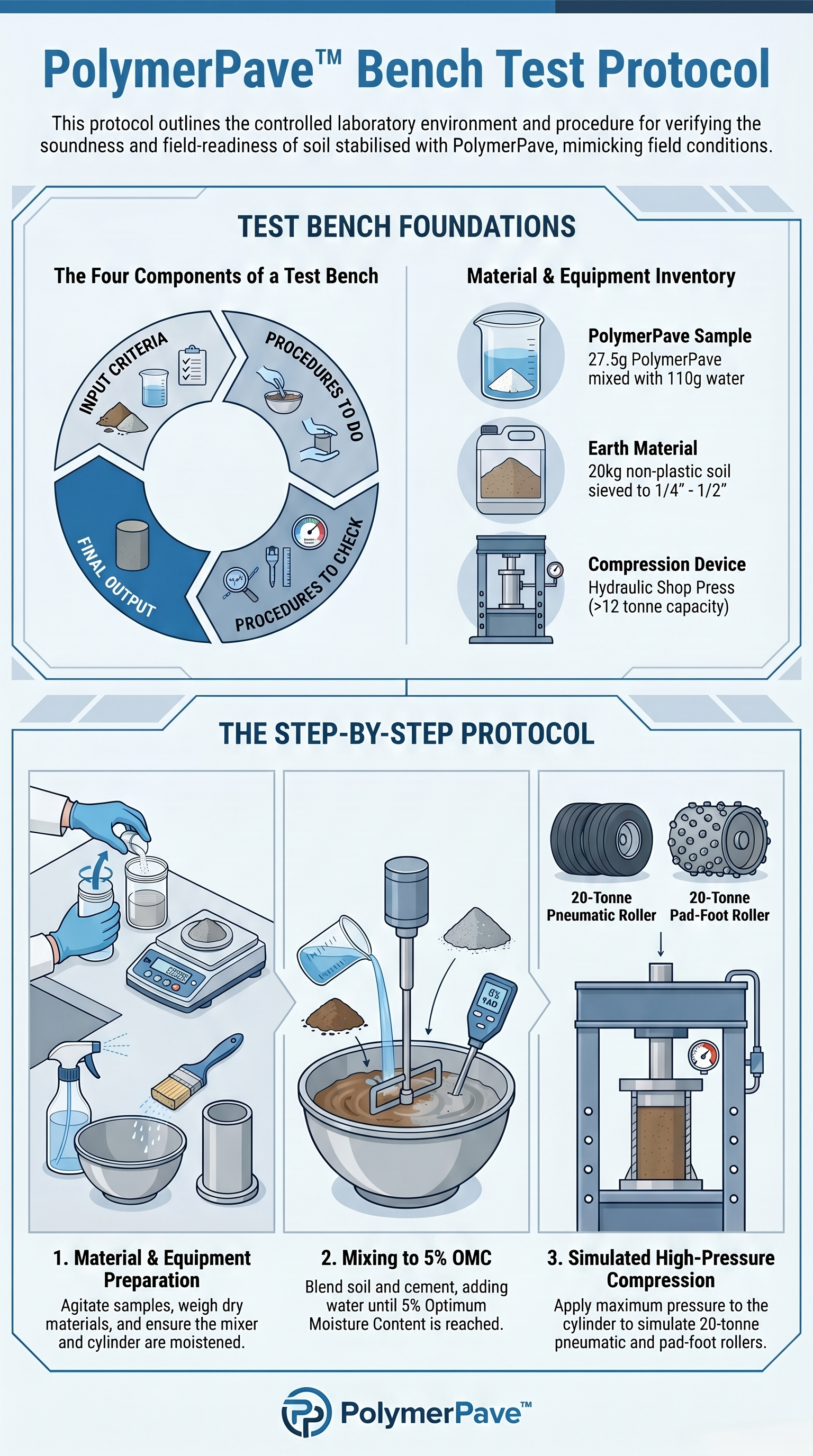
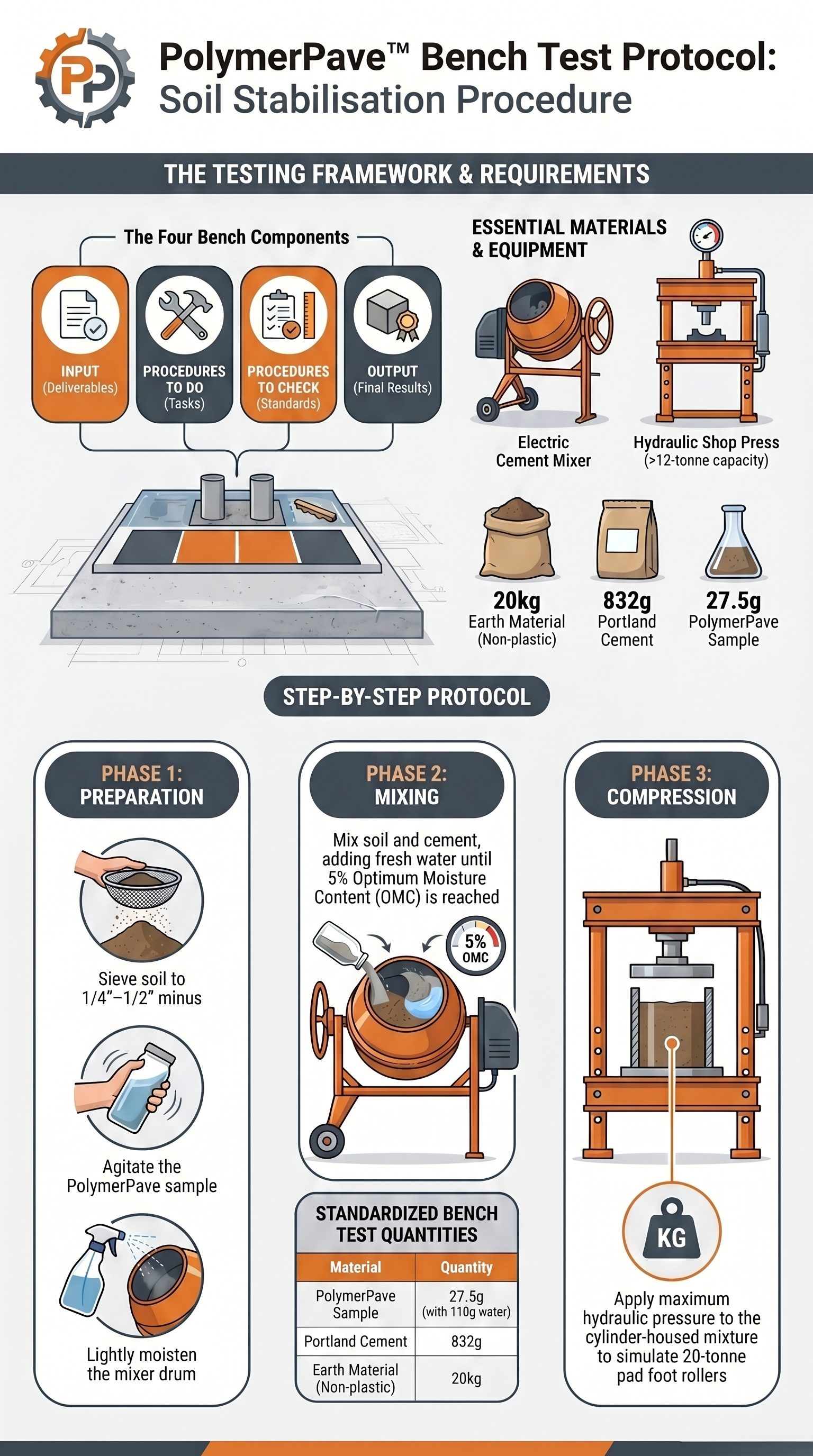
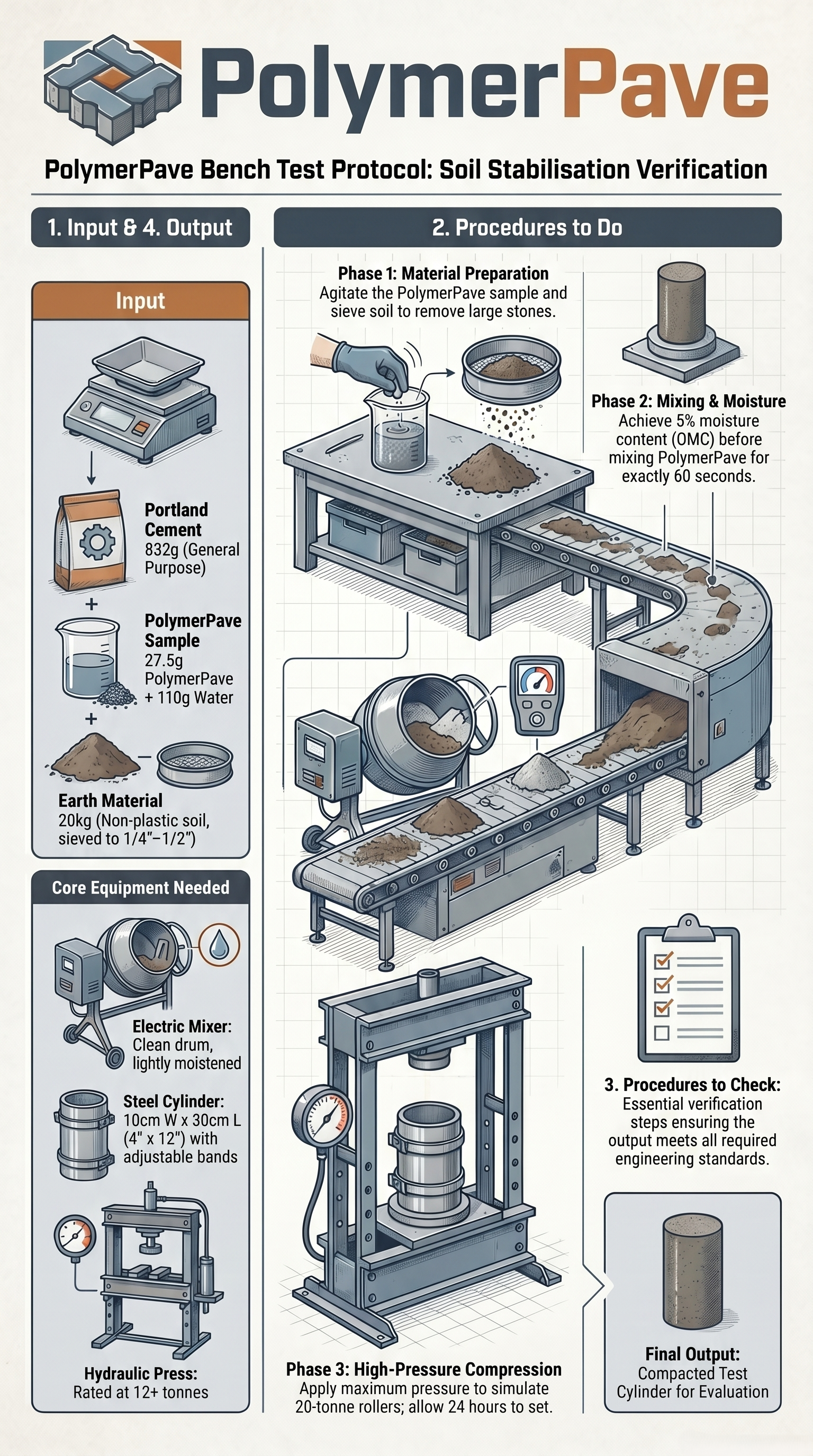
Before full deployment, every project site can conduct a standardized bench test using local soil to independently verify CBR performance. The protocol is straightforward, reproducible, and uses equipment found at any civil engineering laboratory.
↓ Free Download
All three versions cover the same protocol in different visual formats. Choose whichever suits your needs.
↓ Version A — Overview ↓ Version B — Framework ↓ Version C — Step-by-StepSieve non-plastic earth material to ¼"–½" minus. Agitate the PolymerPave sample. Lightly moisten the electric mixer drum to prevent adhesion.
Achieve 5% Optimum Moisture Content (OMC). Combine soil, Portland cement, and PolymerPave solution. Mix for exactly 60 seconds in a rotary drum mixer.
Apply maximum hydraulic pressure (12+ tonne press rated) to the steel cylinder-housed mixture, simulating 20-tonne pad-foot rollers. Allow 24 hours to set.
The compacted test cylinder is evaluated against engineering standards. Results confirm structural performance before full project commitment.
Study: PolymerCrete® as Admixture for Durability Enhancement in Concrete
Preliminary study investigating the effects of PolymerCrete on hydration, strength, and durability properties of cement paste and concrete exposed to dry and moist-curing conditions.
Key finding: unlike commercial polymer emulsions which typically delay cement hydration and reduce strength under moist curing, PolymerCrete showed no retardation of hydration and demonstrated superior strength gains under moist curing conditions — a result the research team described as "quite interesting" and contrary to all established industry precedent for polymer-modified cement composites.
PolymerCrete-modified concrete exceeded reference concrete by 9.3% under moist curing at 30 days — outperforming all known commercial polymer emulsions under the same test conditions.
Rapid Chloride Permeability Test (ASTM C1202) showed a 21% reduction in total charge passed — indicating significantly improved resistance to chloride-induced steel reinforcement corrosion.
PC-modified concrete recorded measurably reduced total porosity vs reference mix (ASTM C642), indicating an enhanced microstructure and contributing to both the strength and durability gains.
Unlike established polymer emulsions (HEC, PVA, styrene-acrylic), PolymerCrete produced no delay in early-age hydration at 0.5% by weight of cement — critical for construction scheduling.
PC-modified concrete retained 20% better workability after 30 minutes vs unmodified reference concrete — improving placement efficiency and compaction quality on site.
Comprehensive analysis of client needs and precise project field surveying. Bench test protocol using local soil to independently confirm CBR performance pre-commitment.
Conception, design, and engineering drawings developed in lockstep with client engineers. Mix formulations customized to local soil type and project specification requirements.
Full management and deployment of works, including engineering oversight, technical support, and crew training on stabilization machinery and PolymerPave application protocols.
Rigorous daily CBR and MPa post-production testing during the rapid roll-out phase. Independent Civil Engineering Firm verification of all structural performance metrics.
Final reports attesting to design conformity, capped with a comprehensive warranty certificate. Complete documentation package for client records and project compliance.
PolymerPave brings new thinking to the construction and rehabilitation of existing airfields — especially in remote and regional locations where aggregate transport represents a disproportionate share of total project cost.
As a transitional product, PolymerPave meets the future needs of regional and remote airfield climate challenges: extreme temperature differentials, saturated sub-grades, and year-round operational requirements. A structurally superior, environmentally responsible alternative to conventional pavement in even the most isolated environments.
Technical partner: Syngensis — Edward "Ted" Turnour, Director | +61 400 735 824 | ted@syngensis.com | www.syngensis.com
Completely eliminates the hazardous chemical leaching associated with traditional asphalt — which contains polycyclic aromatic hydrocarbons that contaminate groundwater and surrounding soil ecosystems.
Greatly reduces greenhouse gas emissions by eliminating external quarrying, heavy transport trucks, and energy-intensive asphalt production. Verified 50% reduction in greenhouse gas footprint.
Utilises existing in-situ materials, preserving natural stone and aggregate reserves. Eliminates quarry operations and all long-haul heavy vehicle transport associated with conventional road construction.
A 25+ year lifespan with near-zero maintenance means fewer reconstruction cycles, fewer material inputs, and dramatically lower lifecycle emissions compared to asphalt requiring resurfacing every 5–8 years.
Carries no UN hazardous chemical number. Requires no special labelling, safety equipment, or handling protocols — safe for workers and surrounding ecosystems throughout application and service life.
The locked polymer matrix does not leach, does not migrate, and does not degrade surrounding soil chemistry or hydrology. Works with saturated clay and PEAT-equivalent substrates without contaminating them.
Whether you are a government agency, civil engineering firm, mining operation, airport authority, or infrastructure developer — PolymerPave Global Corporation invites you to explore what our product line can deliver for your specific project requirements.
We provide technical data sheets, project-specific formulations, bench test protocols, and full engineering support from evaluation through certification.